







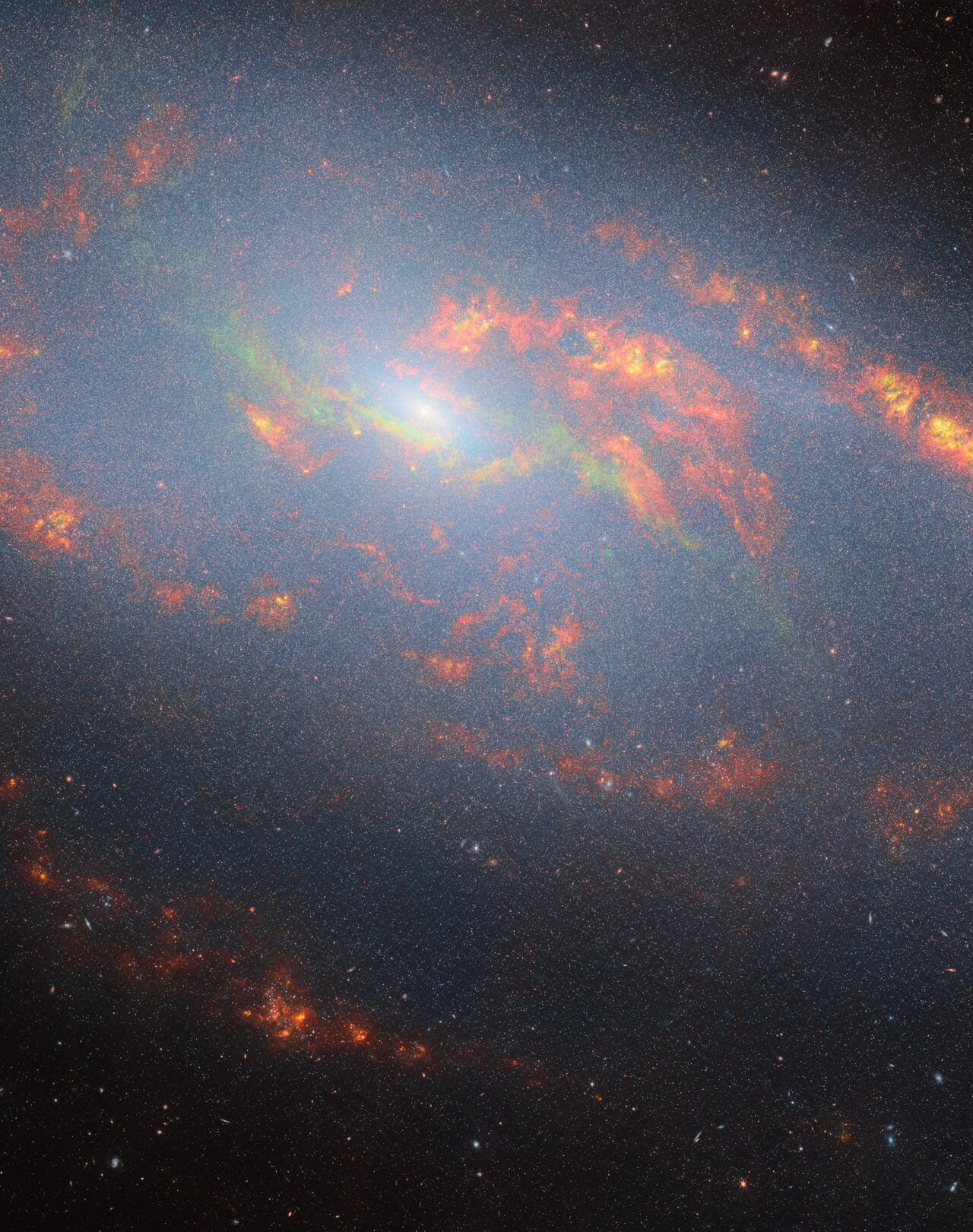
Featured in this new image from the NASA/ESA/CSA James Webb Space Telescope is Messier 106, also known as NGC 4258. This is a nearby spiral galaxy that resides roughly 23 million light-years away in the constellation Canes Venatici, practically a neighbour by cosmic standards. Messier 106 is one of the brightest and nearest spiral galaxies to our own and two supernovae have been observed in this galaxy in 1981 and 2014.At its heart, as in most spiral galaxies, is a supermassive black hole, but this one is particularly active. Unlike the black hole at the centre of the Milky Way, which pulls in wisps of gas only occasionally, Messier 106’s black hole is actively gobbling up material. As the gas spirals towards the black hole, it heats up and emits powerful radiation.This image was captured with Webb’s Near-InfraRed Camera (NIRCam). This observation was taken as part of a dedicated programme to study the galaxy’s Active Galactic Nucleus, the galaxy’s bright central region that is dominated by the light emitted by dust and gas as it falls into the black hole. The blue regions in this image reflect stellar distribution throughout the central region of the galaxy. The orange regions indicate warmer dust and the stronger red hues represent colder dust. The teal, green and yellow tones near the centre of the image depict varying gas distributions throughout the region.The galaxy has a remarkable feature – it is known to have two “anomalous” extra arms visible in radio and X-ray wavelengths, rather than in the visible. Unlike the normal arms, these are composed of hot gas instead of stars. Astronomers believe these extra arms result from the black hole’s activity, a feedback effect seen in other galaxies as well. They are likely caused by outflowing material produced by the violent churning…
Lire l'article complet ici : ESA JWST Picture of The Month: The hidden intricacies of Messier 106