



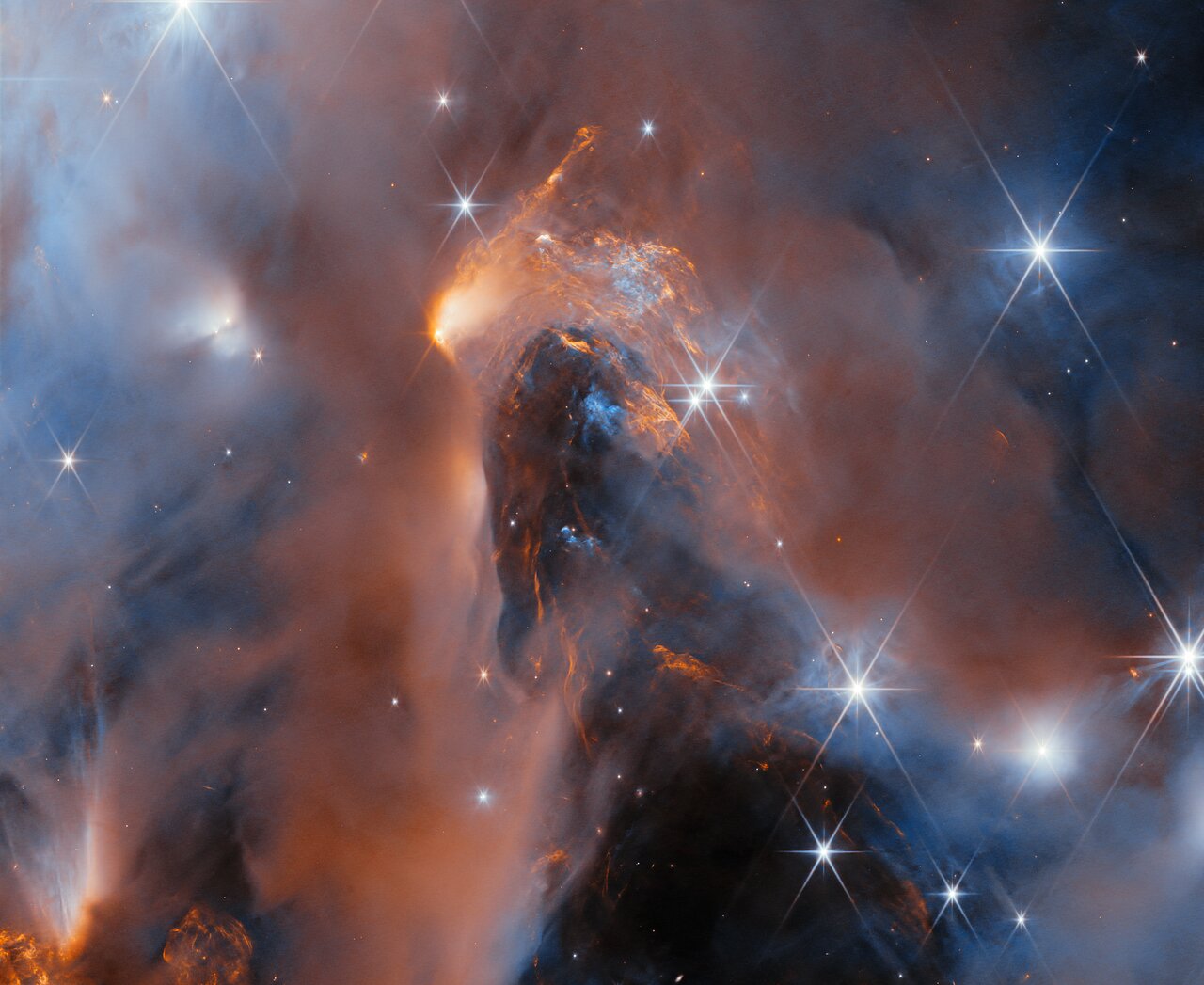
This stunning new mosaic of images from the NASA/ESA/CSA James Webb Space Telescope showcases the nearby star-forming cluster, NGC 1333. The nebula is in the Perseus molecular cloud, and located approximately 960 light-years away.Webb’s superb sensitivity allows astronomers to investigate young objects with extremely low masses. Some of the faintest ‘stars’ in the picture are in fact newly born free-floating brown dwarfs with masses comparable to those of giant planets.The same cluster was featured as the 33rd anniversary image of the NASA/ESA Hubble Space Telescope in April of 2023. Hubble’s image just scratched the surface of this region, because clouds of dust obscure much of the star formation process. Observing with a larger aperture and in the infrared part of the spectrum, Webb is capable of peering through the dusty veil to reveal newborn stars, brown dwarfs and planetary mass objects. The centre of the image presents a deep peek into the heart of the NGC 1333 cloud. Across the image we see large patches of orange, which represent gas glowing in the infrared. These so-called Herbig-Haro objects form when ionised material ejected from young stars collides with the surrounding cloud. They are hallmarks of a very active site of star formation.
Lire l'article complet ici : ESA JWST Picture of The Month: Peeking into Perseus