












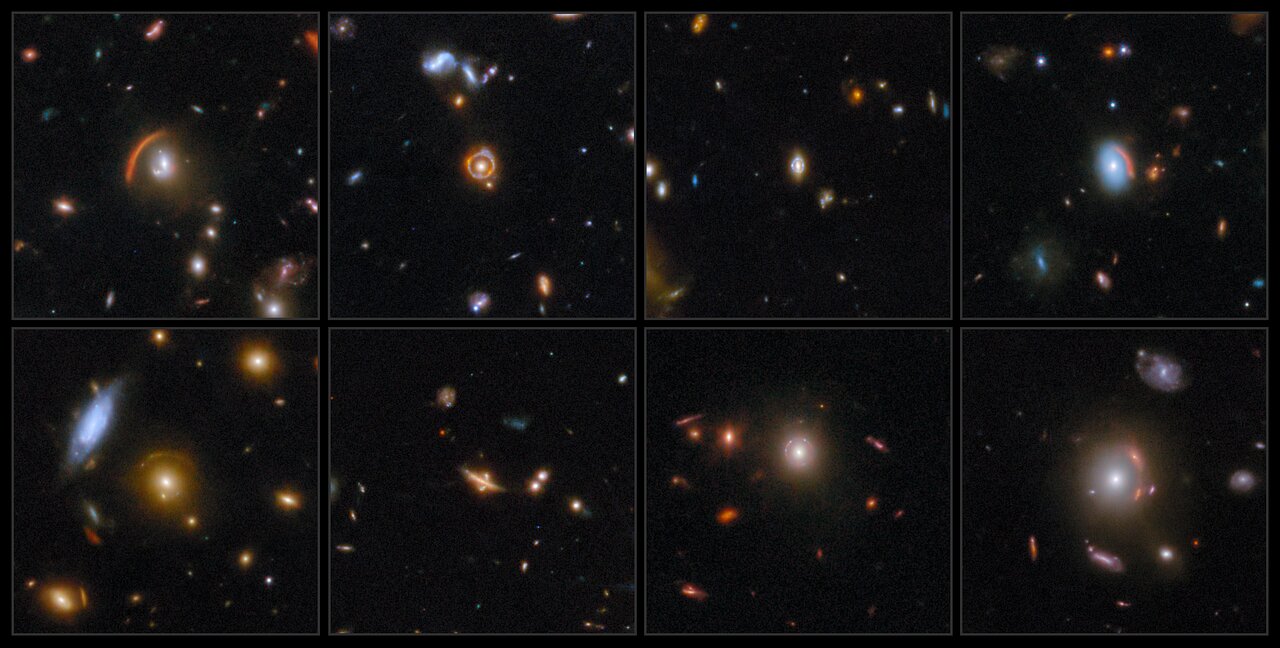
This ESA/Webb Picture of the Month shows eight stunning examples of gravitational lensing. Gravitational lensing, which was first predicted by Einstein, occurs because massive objects like galaxies and clusters of galaxies dramatically warp the fabric of spacetime. When a massive foreground object lines up just so with a background galaxy, the light from the background galaxy bends as it navigates the warped spacetime on its way to our telescopes.Depending on how perfect the alignment is, the light from the background galaxy can be bent into an arc, a circle (a phenomenon called an ‘Einstein ring’) or even split into multiple images.Arcs and circles are prevalent in these gravitationally lensed galaxies, which were identified in data from COSMOS-Web, a 255-hour Treasury programme (#1727). COSMOS-Web aims to understand the formation of the most massive galaxies in the Universe, identify galaxies that were present when the first stars and galaxies reionised the Universe’s hydrogen gas, and study the relationship between the mass of a galaxy’s stars and the mass of its galactic halo across cosmic time.Using these data, researchers carried out the COSMOS-Web Lens Survey, or COWLS, to search for gravitational lenses. The researchers inspected more than 42 000 galaxies by eye and picked out more than 400 promising lensing candidates. This Picture of the Month feature presents a collage of eight of the most spectacular lenses identified by the research team.
Lire l'article complet ici : ESA JWST Picture of The Month: Webb brings cosmic lenses into focus