


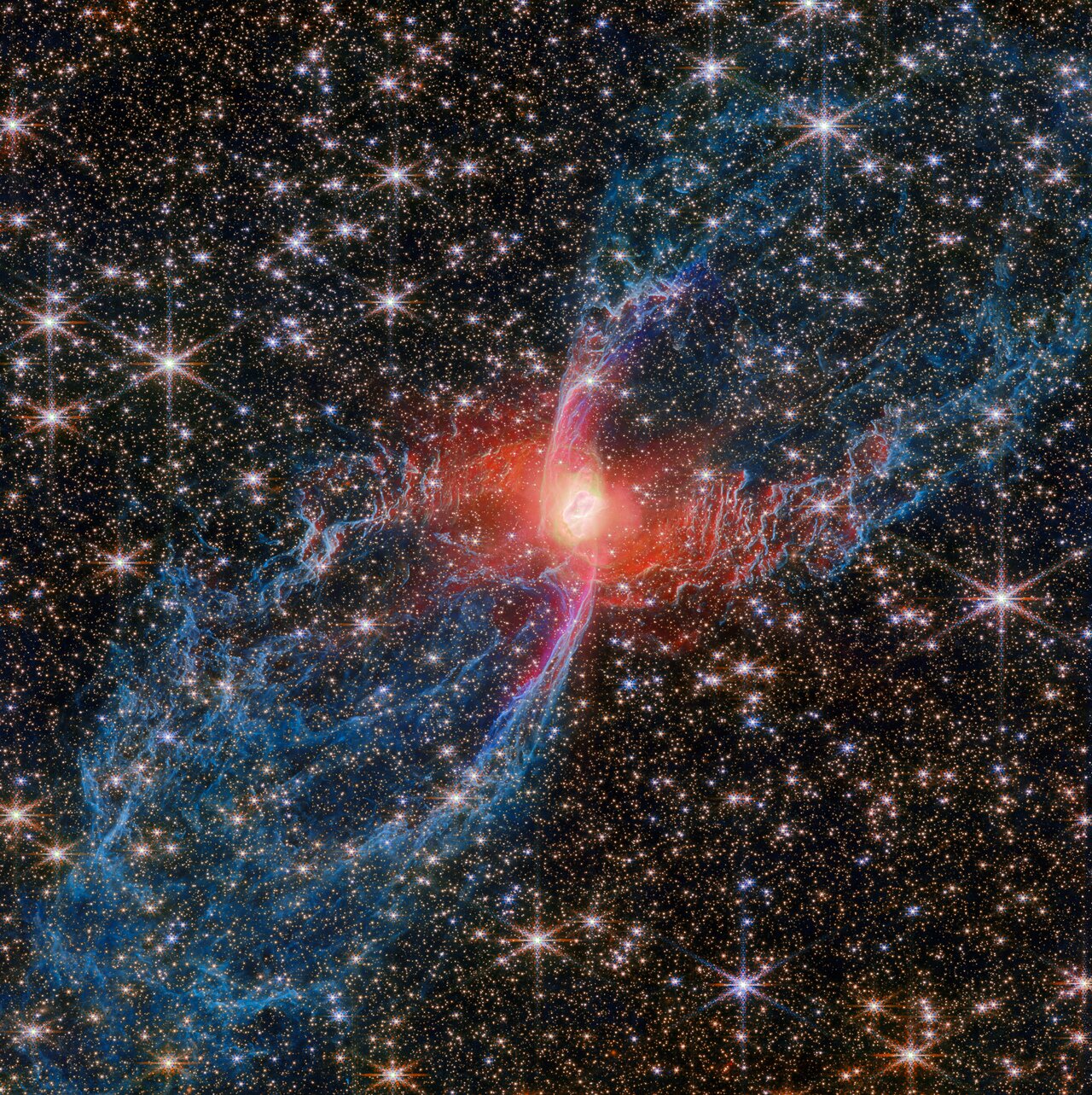
This new NASA/ESA/CSA James Webb Space Telescope Picture of the Month features a cosmic creepy-crawly called NGC 6537 — the Red Spider Nebula. Using its Near-InfraRed Camera (NIRCam), Webb has revealed never-before-seen details in this picturesque planetary nebula with a rich backdrop of thousands of stars. Planetary nebulae like the Red Spider Nebula form when ordinary stars like the Sun reach the end of their lives. After ballooning into cool red giants, these stars shed their outer layers and cast them into space, exposing their white-hot cores. Ultraviolet light from the central star ionises the cast-off material, causing it to glow. The planetary nebula phase of a star’s life is as fleeting as it is beautiful, lasting only a few tens of thousands of years.The central star of the Red Spider Nebula is visible in this image, glowing just brighter than the webs of dusty gas that surround it. The surprising nature of the nebula’s tremendously hot and luminous central star has been revealed by Webb’s NIRCam. In optical-wavelength images, such as from the NASA/ESA Hubble Space Telescope, the star appears faint and blue. But in the NIRCam images, it shows up as red: thanks to its sensitive near-infrared capabilities, Webb has revealed a shroud of hot dust surrounding the central star. This hot dust likely orbits the central star, in a disc structure.Though only a single star is visible in the Red Spider’s heart, a hidden companion star may lurk there as well. A stellar companion could explain the nebula’s shape, including its characteristic narrow waist and wide outflows. This hourglass shape is seen in other planetary nebulae such as the Butterfly Nebula, which Webb also recently observed.
Lire l'article complet ici : ESA JWST Picture of The Month: The Red Spider Nebula, caught by Webb