



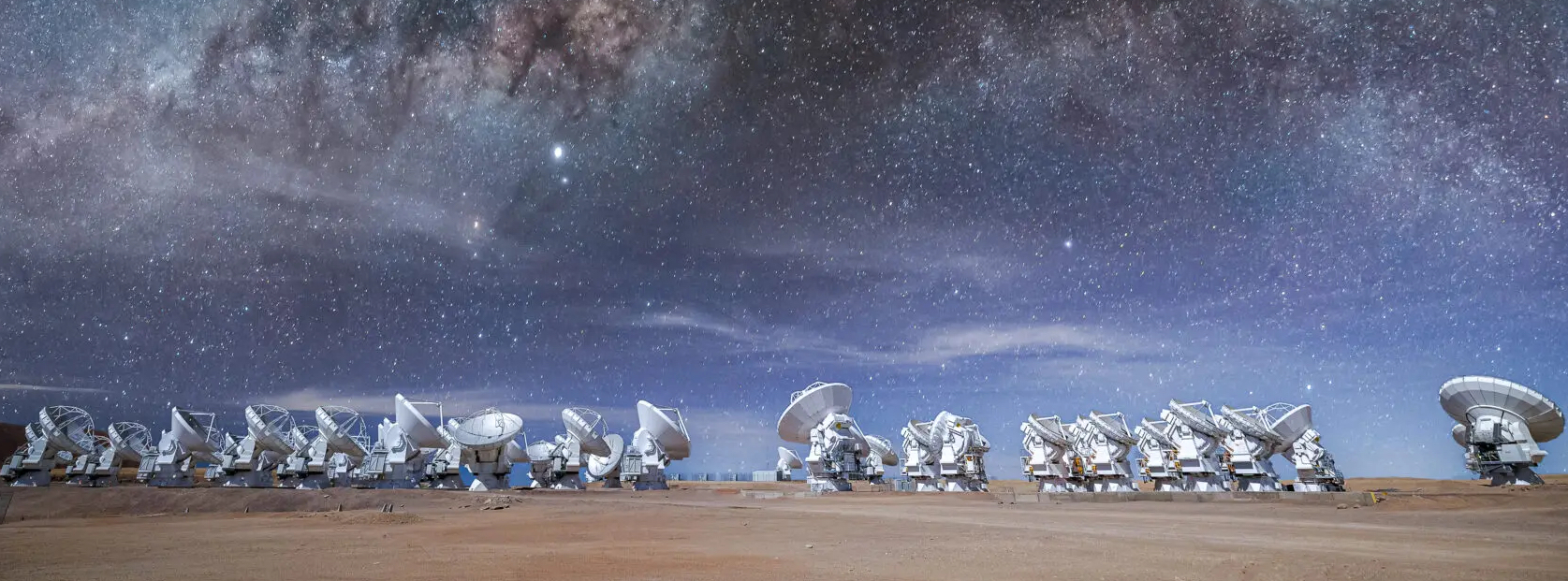
ALMA and the NSF VLA reveal circumnuclear “ring factories” where massive star clusters form and evolve in nearby galaxies ALMA revealed a population of young massive cluster candidates hidden within dense star-forming rings surrounding the centers of two nearby spiral galaxies. By tracing both cold dust and ionized gas, ALMA helped astronomers distinguish cluster candidates at different stages of their early evolution. The study provides one of the most detailed radio views to date of massive cluster formation in circumnuclear rings. Nearby galaxies such as NGC 3351 and NGC 1097 offer a unique opportunity to study star formation processes similar to those common in galaxies billions of years ago. Astronomers have used the Atacama Large Millimeter/submillimeter Array (ALMA) and the U.S. National Science Foundation Karl G. Jansky Very Large Array (VLA) to peer through thick curtains of cosmic dust and build one of the clearest pictures yet of how massive star clusters are born in the hearts of nearby galaxies. Focusing on two barred spiral galaxies, NGC 3351 and NGC 1097, the team identified young massive cluster candidates at different stages of their early evolution, from deeply embedded, dust-shrouded objects to systems that have already begun clearing their surroundings — revealing objects that optical telescopes, and even many infrared observations, cannot see at all.In many spiral galaxies, gas flowing inward along a central bar piles up in a dense, star-forming ring a few hundred to a thousand light-years from the galactic core, acting like a cosmic factory for massive star clusters. In NGC 3351 and NGC 1097, these circumnuclear rings pack gas into compact, high-pressure clumps and ignite bursts of star formation at rates and densities similar to those seen in typical galaxies when the Universe was only a few billion years old — making them nearby stand-ins for the…
Lire l'article complet ici : Alma Observatory: ALMA Lifts the Veil on Hidden Nurseries of Massive Star Clusters in Nearby Galaxies