


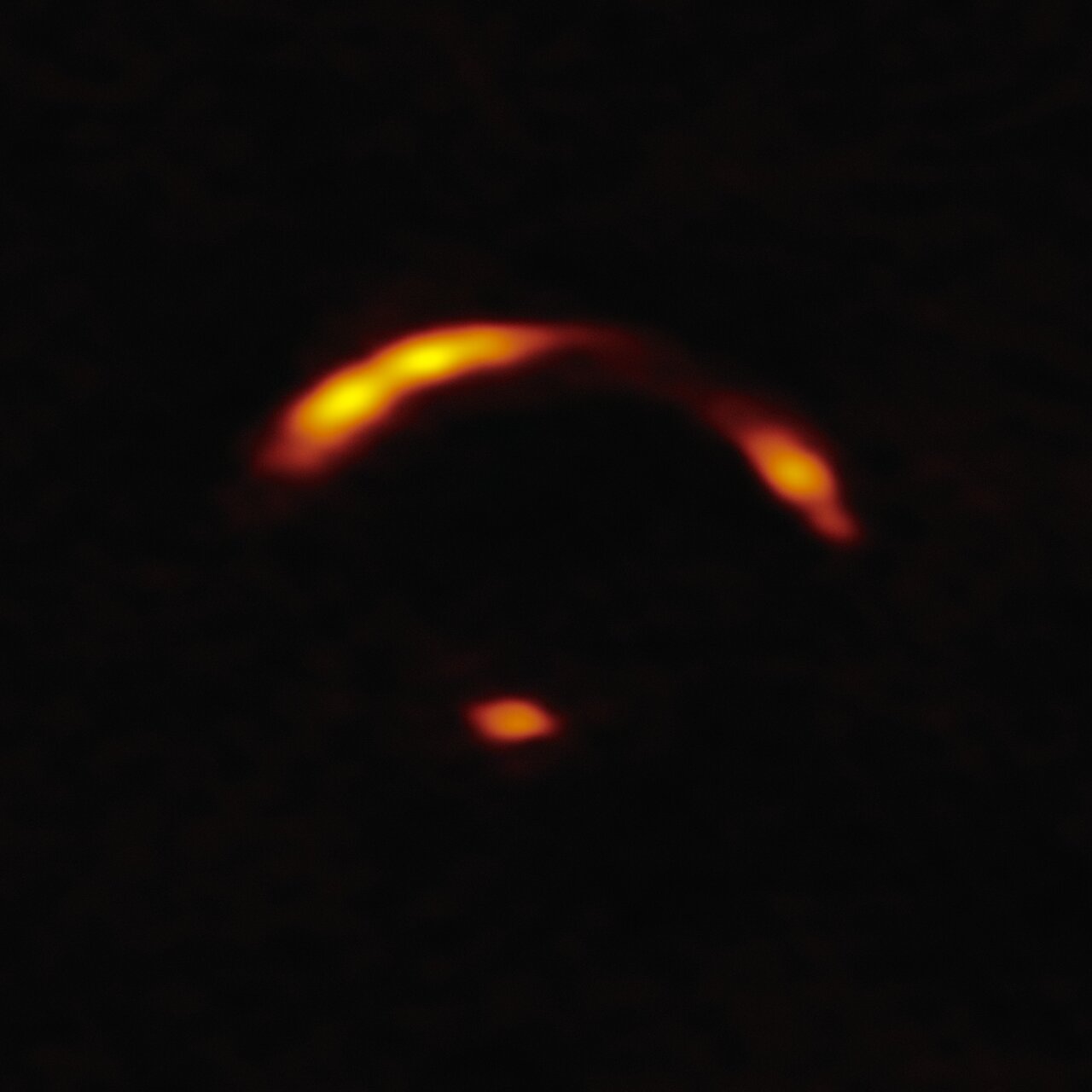
Gravitational lensing allowed astronomers to study a compact, dust-obscured galaxy from 11 billion years ago that is the most plausible counterpart candidate to an IceCube neutrino event ALMA resolved a distant, dust-obscured galaxy into four gravitationally lensed images and revealed an extremely compact region of intense star formation. The galaxy, nicknamed “Shadow Blaster,” lies within the localization region of the high-energy neutrino event IC 210922A. Its position, rarity, and dense, gas-rich core make it the most plausible electromagnetic counterpart candidate identified within the neutrino’s localization region, although a chance alignment cannot be ruled out. The findings suggest that populations of compact starburst galaxies during “Cosmic Noon” may make a meaningful but subdominant contribution to the high-energy neutrino background. Astronomers using the Atacama Large Millimeter/submillimeter Array (ALMA) have revealed the hidden structure of an intensely star-forming galaxy as it appeared nearly 11 billion years ago. Located in the same patch of sky as a high-energy neutrino detected by the IceCube Neutrino Observatory, the galaxy is the most plausible electromagnetic counterpart yet identified for that event.Officially designated JCMT0402−0424 and nicknamed “Shadow Blaster,” the galaxy is so deeply obscured by dust that it is nearly invisible at optical wavelengths. ALMA observations showed that its light has been magnified and distorted by the gravity of a massive foreground galaxy, splitting it into four separate images. By combining ALMA’s high-resolution data with gravitational-lens modeling, the research team reconstructed the galaxy’s true structure and probed the dense gas fueling its starburst.
Lire l'article complet ici : Alma Observatory: ALMA Reveals a Hidden Starburst Galaxy Linked to a High-Energy Neutrino