







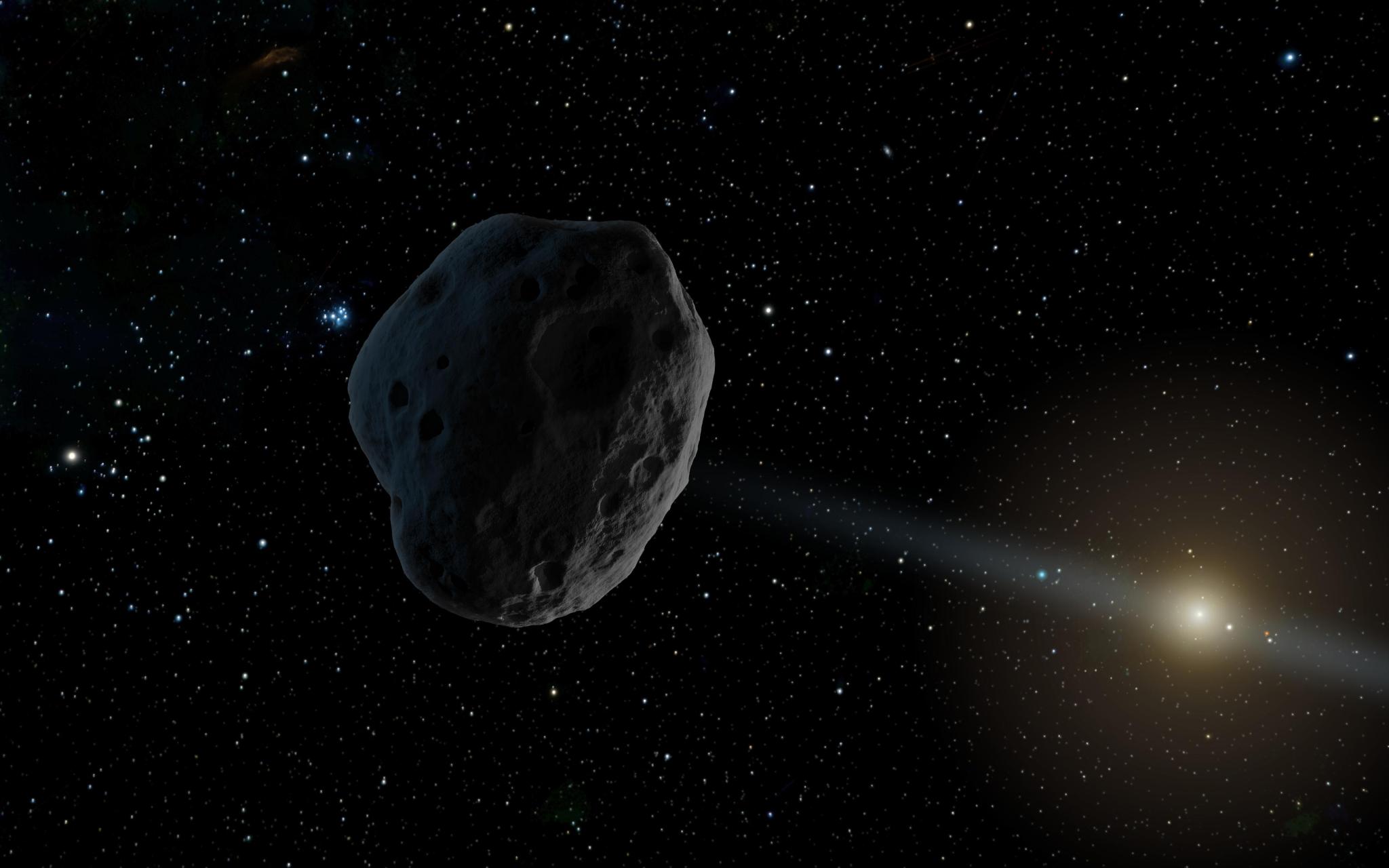
New research led by scientists at NASA’s Jet Propulsion Laboratory in Southern California has revealed the identity of a puzzling near-Earth object by precisely tracking its motion through space and using powerful observatories that image faint celestial objects.This object has a dual personality: Past images hadn’t revealed obvious cometlike activity, suggesting it might be an asteroid, but its motion recently proved to be irregular like that of a comet. The scientists detailed their findings in a study published in the journal Nature Astronomy.The puzzle began on Aug. 28, 2025, when the object, provisionally known as the asteroid 1998 SH2, passed safely within 2 million miles (3 million kilometers) of our planet during its 4½-year orbit around the Sun. Researchers looking to observe 1998 SH2 with NASA’s Deep Space Network (DSN) planetary radar system had calculated its position using data from previous orbits and factored in the effects that the gravity of the Sun and planets would have on its path. But when 1998 SH2 didn’t show up where they expected, they realized that something unanticipated had been influencing the object’s motion.By using optical astrometry to precisely measure the object’s position in the sky, the researchers were able to identify the cause.“After we measured the nongravitational perturbations affecting the motion of 1998 SH2 and recognized they weren’t compatible with the object being an asteroid, we suspected the object could be an active comet,” said Davide Farnocchia, a navigation engineer with NASA’s Center for Near-Earth Object Studies at JPL and study lead.Although 1998 SH2’s orbit around the Sun had been well-tracked from 1998 to 2016, the object had completed two solar orbits without additional observations by telescopes until the 2025 DSN attempts. Analyzing all observations collected since the object’s discovery in 1998, researchers determined the perturbations to 1998 SH2’s motion and hypothesized that the object may be generating a small thrust by venting gas into space, causing it to deviate from its predicted path.This venting results from the Sun heating ice mixed with rocky material, turning the ice into a gas. With regular comets, this activity forms a trademark bright tail and coma — the gas and dust surrounding a comet’s nucleus. But when an object produces gas and dust in much smaller quantities, its tail and coma may not be detectable to most observatories.The August 2025 close approach to Earth of 1998 SH2 provided the perfect opportunity for the paper’s authors…
Lire l'article complet ici : NASA News: NASA Study Finds Near-Earth Asteroid Is Actually Comet