



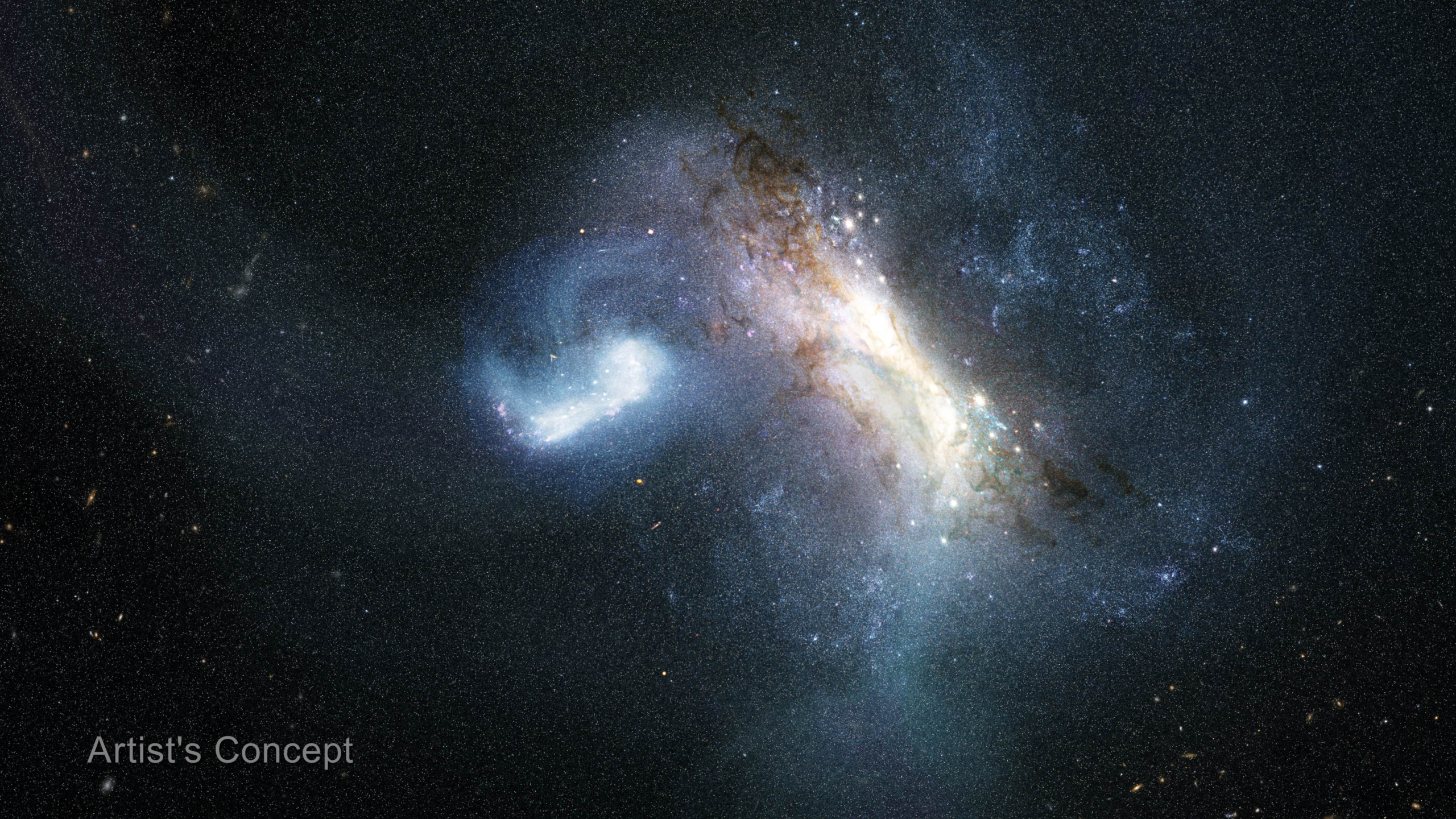
Our home galaxy, the Milky Way, grew to its current size in part by consuming smaller galaxies. Now, new data from NASA’s Hubble Space Telescope shows definitive evidence of a dwarf galaxy merging with the young Milky Way galaxy in the earliest phases of its evolution. This finding extends our knowledge of our galaxy’s history 1.8 billion years farther back in time than before.The results published Monday in the journal Nature Astronomy.The Milky Way today is a massive spiral galaxy home to hundreds of billions of stars. However, our galaxy wasn’t always so large; it has grown by forming new stars from its gas clouds as well as collecting stars, gas, and dark matter from other galaxies through mergers.The most recent massive merger in our galaxy’s history took place with the Sagittarius dwarf galaxy, beginning over 6 billion years ago and still ongoing today. Looking back into the even more distant past, researchers learned that the Milky Way galaxy consumed another dwarf galaxy called Gaia-Sausage-Enceladus 10 billion years ago. This ancient merger greatly affected the structure of our galaxy’s disk of stars. Other, smaller mergers occurred between these two.But our galaxy’s history doesn’t stop there. Both observations and simulations have suggested that another large merger preceded these two, though the specifics of the event have been heavily debated. Now, Hubble has uncovered definitive evidence of an earlier merger that occurred about 11.8 billion years ago, or just 2 billion years after the big bang.“Our home is the Milky Way galaxy, but we do not know how our house was built,” said Davide Massari, lead author, Astrophysics and Space Science Observatory of Bologna in Italy. “In this paper we discover where the first significant batch of bricks came from: a dwarf galaxy that we call LKH.”Immense astronomical surveys and precision data from spacecraft like ESA’s (European Space Agency’s) Gaia mission have been instrumental in piecing together the history of our galaxy. The farther back into our galaxy’s history that scientists attempt to look, the more difficult it becomes to tell what happened. When our galaxy was young, it was smaller and much closer in size to the galaxies it clashed with. It was also more chaotic, and it’s possible that the signs of mergers have been erased over billions of years.It’s into this murky past that Hubble peered. Researchers used Hubble to study some of the Milky Way galaxy’s globular clusters:…
Lire l'article complet ici : NASA News: Hubble Solves Merger Mystery From Milky Way’s Early Years