



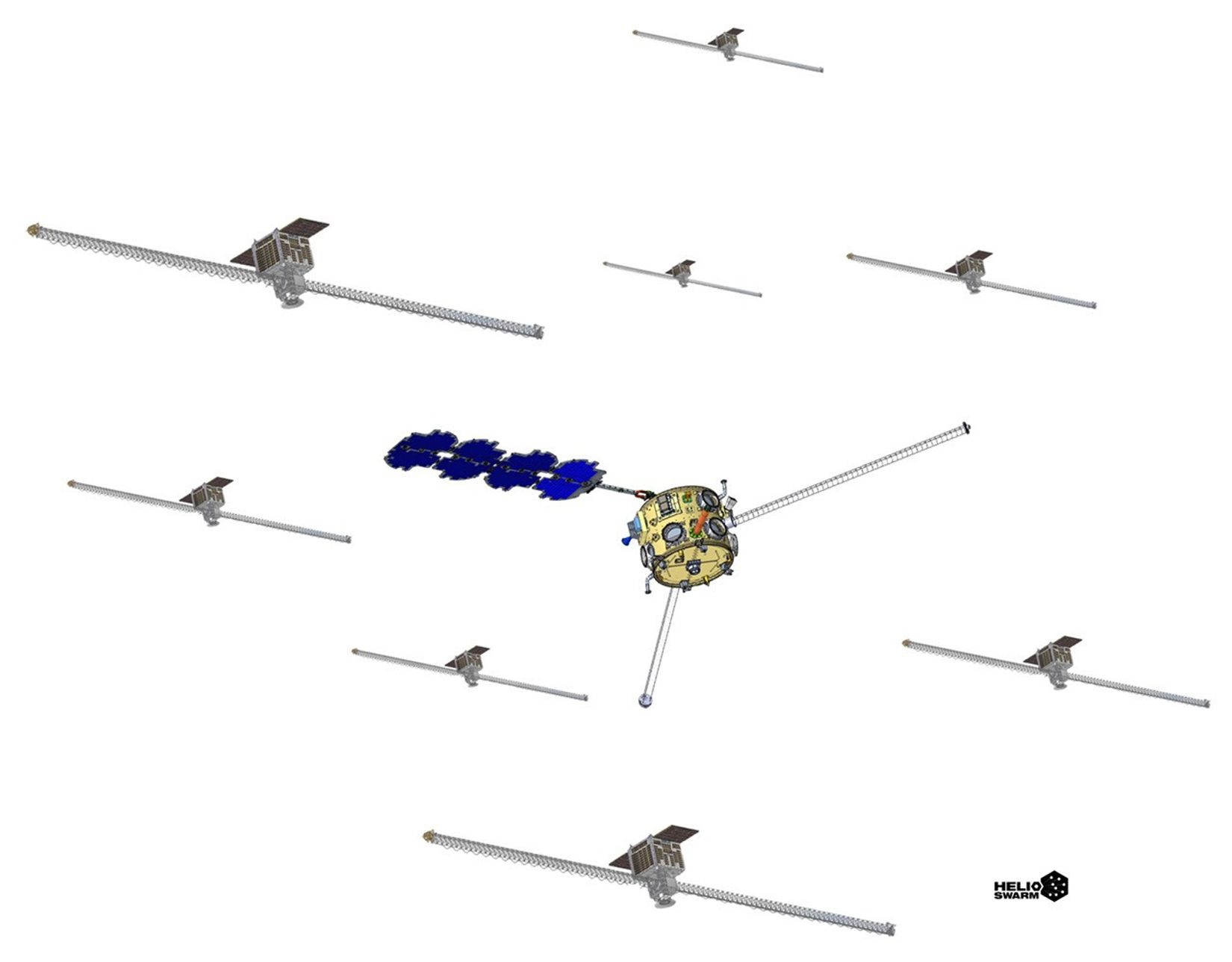
Fully autonomous space mission operations require the ability to detect faults and compensate for them without human intervention. To address this challenge and provide model-based support for system design and operations, it is important to connect fault management (FM) and model-based systems engineering (MBSE). This approach was successfully demonstrated with the model-based generation of a failure modes and effects analysis and fault trees using NASA’s HelioSwarm mission early design information.As NASA strives to push the boundaries of space travel with the Artemis program and the agency’s upcoming deep-space science missions, increased system autonomy and resiliency have inevitably become key technology needs. Autonomous operations require fault management (FM) software to detect issues that occur in space so they can be mitigated automatically without human intervention. Designing autonomous missions requires a multi-disciplinary approach that connects FM with the model-based systems engineering (MBSE) approach used in mission design to ensure that resilient, fault-tolerant systems are architected, modeled, and integrated during the design phase.To address this need, NASA awarded a Phase II Small Business Innovation Research (SBIR) contract to Qualtech Systems Inc. (QSI) for development of FM capabilities and enhancements to its commercially available toolset, TEAMS® (a product that resulted from commercialization of the company’s earlier NASA-sponsored SBIR work), to support HelioSwarm and other NASA heliophysics missions.One of the most important tasks in this effort was to connect system health management (SHM) and FM to the systems engineering (SE) process. Together, SHM/FM consists of a set of mechanisms that ensure that mission goals are achieved by preventing failures from occurring, or detecting and then mitigating them if they do occur. The SE process coordinates, cross-checks, and integrates system elements to achieve mission goals and is integral during the design, specification, and verification and validation (V&V) of systems. NASA often employs a model-based approach for its SE process, using Systems Modeling Language (SysML) as the framework.Despite their inherently close relationship to SE in practice, SHM/FM practices have typically not been tightly integrated with SE. Often, SHM/FM is incorporated only after a nominal system is designed, which essentially makes SHM/FM a bandage fix for problems after they occur, without considering how issues might have been prevented. In addition, SE and SHM/FM often involve separate sets of subject matter experts with stove-piped knowledge repositories. This situation can lead to use of modeling methodologies and analyses processes that yield inconsistent results, and can potentially result in inefficiencies throughout…
Lire l'article complet ici : NASA News: Integrating Model-Based Systems Engineering and Fault Management to Enable Autonomous Space Missions