







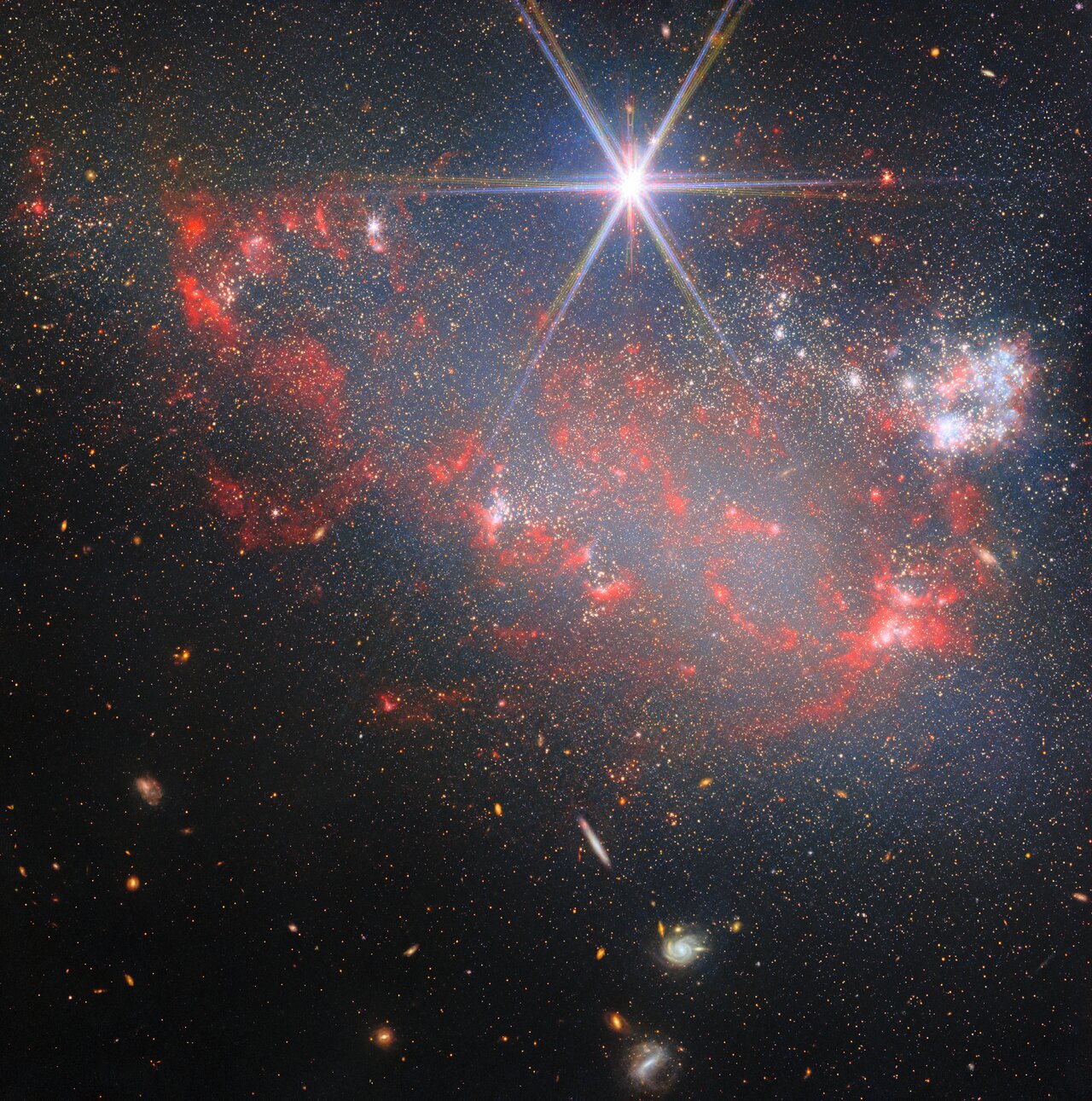
The latest ESA/Webb Picture of the Month is a new, infrared look into the strange final phase of a galactic merger. Arp 263, an irregular galaxy, lies in the constellation Leo at a relatively nearby distance of around 25 million light-years.Originally discovered in 1784 and also catalogued as NGC 3239, this galaxy was included in American astronomer Halton Arp’s Atlas of Peculiar Galaxies in 1966, as possibly one of the most remarkable and strange galaxies in the sample. Arp categorised it with the galaxies featuring “irregular clumps”. In 2023, the galaxy was featured in an image from the NASA/ESA Hubble Space Telescope, where these clumps are revealed to be bright nebulae between the galaxy’s dense clouds of gas, where stars are forming.Arp 263 is believed to result from a past galactic merger. Apart from its unusual distorted shape, astronomers have noticed a few features that point to this. It has two short, curved tails of stars, beyond the field of view of this Webb image, which are a feature that’s associated with gravitational interactions. However, there are no nearby galaxies that Arp 263 could be interacting with now. The stars in the galaxy are oriented differently to its hydrogen gas, where they would normally be symmetric, and parts of that gas are moving at different velocities to each other. And, of course, the widespread formation of new stars across Arp 263 is typical of a galaxy whose gas has been seriously shaken up.Although Arp 263 clearly hasn’t yet settled into a more regular shape after its gravitational tug-of-war, its former companion galaxy is now nowhere to be found. It’s possible that this was a dwarf galaxy small enough to have been already completely dissolved into the larger Arp 263 — or that its companion was simply much more heavy than…
Lire l'article complet ici : ESA JWST Picture of The Month: Striking star clusters and irregular clumps