







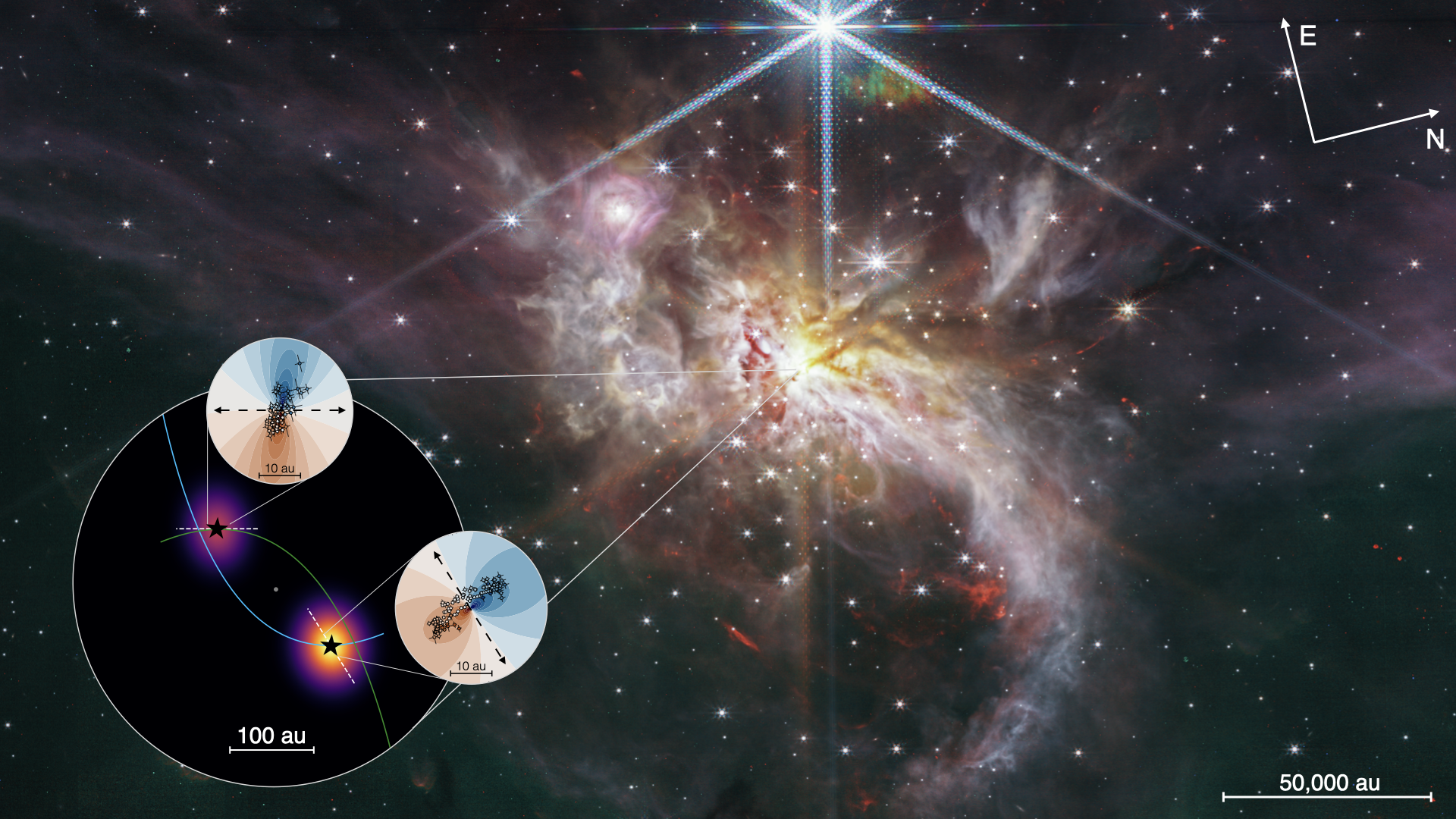
Using the Atacama Large Millimeter/submillimeter Array (ALMA), astronomers have captured one of the most detailed three-dimensional views yet of a massive binary star system while it is still being born. By tracking the motions of two young, massive stars over nearly eight years, the team found that the pair follows a highly stretched-out orbit and is surrounded by strongly tilted gas disks, both relative to each other and to the stars’ orbit. The findings suggest the two stars didn’t form together from a single spinning disk of material, as is often assumed, but instead formed independently and later came together in a close gravitational encounter, revealing a new way close massive binary star systems may form.Most massive stars are born with stellar companions, and at least 90% are thought to exist in binary or higher-order multiple systems. These massive binaries go on to shape their surroundings dramatically, through supernova explosions and the production of heavy elements. But because most known massive binaries are only studied long after they’ve finished forming, astronomers have had few opportunities to catch the actual moment of assembly.An international team led by Yichen Zhang of Shanghai Jiao Tong University set out to change that by studying IRAS 07299−1651, a system containing two massive protostars, stars still growing by pulling in surrounding gas and dust. The team had studied this system before, in 2019, when ALMA observations first provided direct dynamical constraints on the pair. At the time, the results seemed broadly consistent with the standard picture: two stars forming together from the fragmentation of one large disk. But one detail didn’t quite fit: the disks around the two stars already looked oddly misaligned.To dig deeper, the researchers spent nearly eight years measuring extremely subtle shifts in the two stars’ positions on the sky, a technique that requires…
Lire l'article complet ici : Alma Observatory: ALMA Watches a Massive Binary Assemble in Real Time