



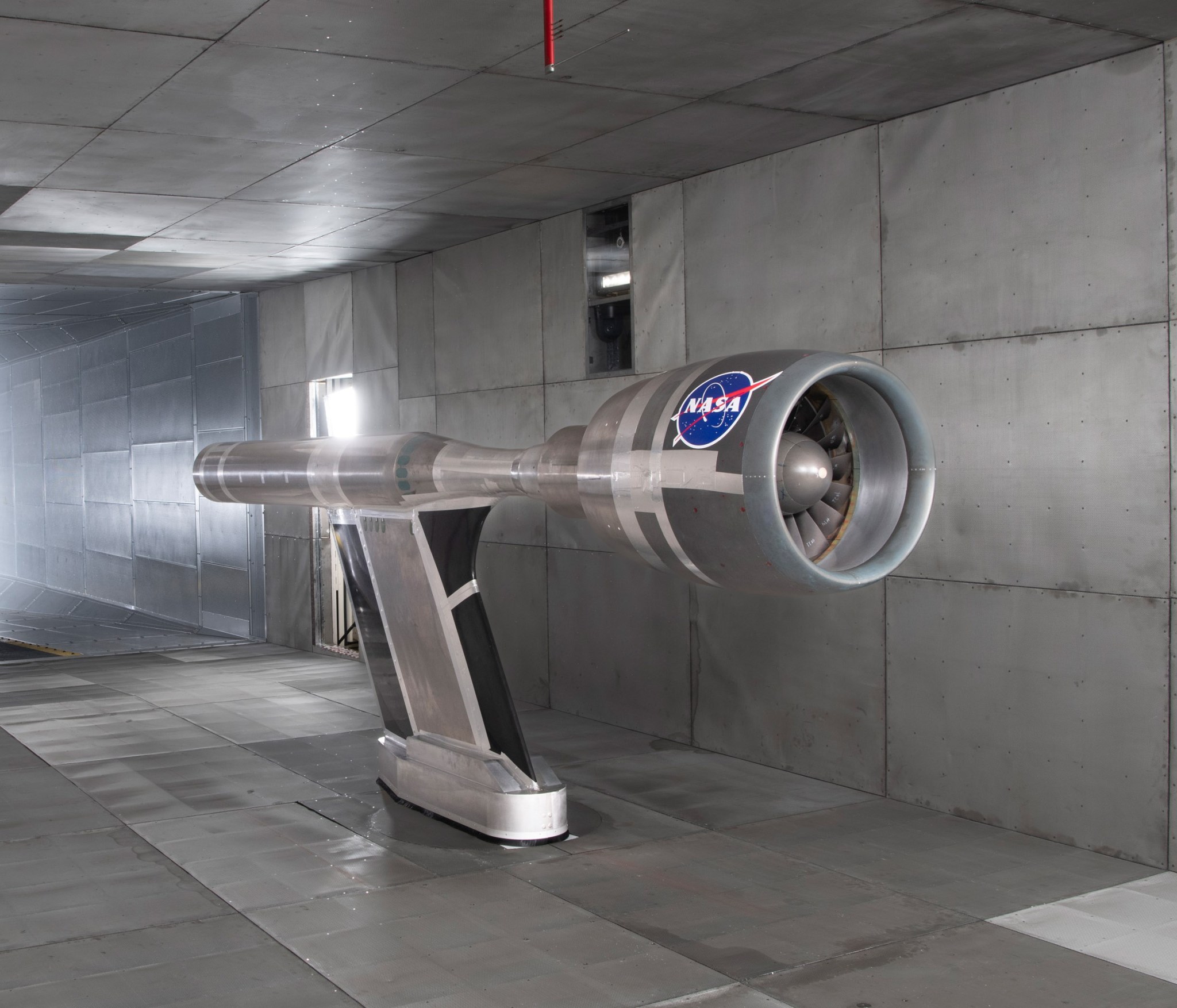
Research teams at the NASA Glenn Research Center perform experiments in world-class facilities such as the 9- by 15-Foot Low-Speed Wind Tunnel (9 x15 LSWT), the Aero-Acoustic Propulsion Laboratory (AAPL), the Small Hot Jet Acoustic Rig (SHJAR), the Nozzle Acoustic Test Rig (NATR), the DGEN AeroPropulsion Research Turbofan (DART), and the Acoustical Testing Laboratory (ATL).The 9- by 15-Foot Low Speed Wind Tunnel is specially designed to give researchers a controlled environment to study aircraft engine aerodynamics and acoustics at takeoff and landing conditions. This helps us to reduce noise in communities near airports. Major modifications were completed in 2019 to improve the flow and lower the background noise of the tunnel. A new 5-sensor traversing microphone rake helps measure sound produced by scale experimental propulsors. Read more about the capabilities of the 9 x 15 LSWT on our facilities page.The Aero-Acoustic Propulsion Laboratory (AAPL) is a dual-purpose 65-foot radius geodesic dome used to reduce community noise and perform aeroacoustic tests of aircraft engines and engine components. The test area inside the dome can be configured as a hemi-anechoic or anechoic chamber. There are no echoes in the dome during tests because 17,000 custom-designed 2-ft thick fiberglass wedges are mounted to the inside surface of the dome walls and placed on the floor and around test rigs to absorb sound and prevent sound reflections. When AAPL was constructed in 1993, it was the first known free-standing geodesic dome to include materials to reduce transmission of sound through the walls and absorb sound within it. AAPL currently houses the Nozzle Acoustic Test Rig (NATR), Small Hot Jet Acoustic Rig (SHJAR), and the DGEN 380 Aeropropulsion Research Turbofan (DART). Read more about the capabilities of the AAPL on our facilities page.SHJAR is one of three rigs installed inside the anechoic dome of the Aeroacoustic Propulsion Lab. It can be used to test single stream nozzles up to 5 cm in diameter, Mach 2.0 and 800 K. SHJAR is a key tool in connecting the dots between nozzle geometry, jet flow, and noise. Creative nozzle designs are inexpensively created for this rig, and their impact on flow and noise is measured with world-leading measurement techniques. Researchers at NASA Glenn have been using SHJAR to develop advanced flow measurement techniques like Rayleigh Scattering, Raman Scattering, digital Schleiren, and real-time Particle Image Velocimetry. Three-dimensional microphone arrays have been deployed to map the sources of the noise.…
Lire l'article complet ici : NASA News: Experimental Facilities