






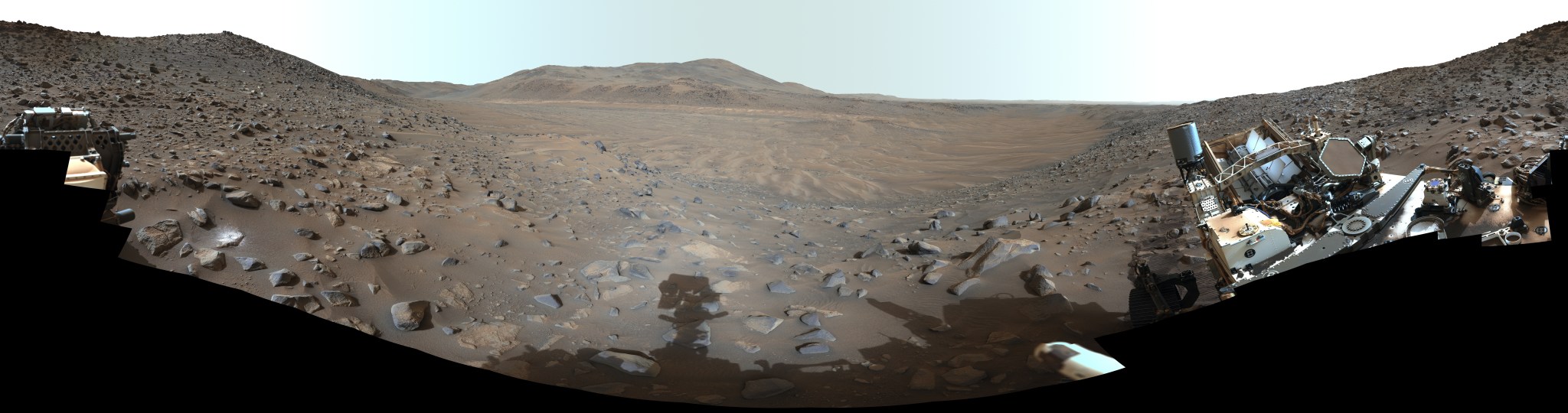
Over 1,645 Martian days, NASA’s Perseverance Mars rover measured the fine and ultrafine Martian dust particles found clinging to samples of spacesuit materials that are carried aboard the rover, including some that are small enough to penetrate the lungs and enter the bloodstream. The findings will be published Tuesday, Oct. 27, in the Proceedings of the National Academy of Sciences and could inform spacesuit and habitat design, dust-removal procedures, and crew health standards for future NASA missions to Mars.“NASA has a long history of turning challenges into workable solutions and of finding creative ways to use the data that we have to answer questions beyond what it was originally collected for,” said Lindsay Hays, acting director, Planetary Science Division, NASA Headquarters in Washington. “Dust has been a surface-exploration challenge since the Apollo program. Perseverance is giving our engineers and flight surgeons measurements they can use to improve our existing designs well before the first American astronauts arrive on Mars.”Lunar dust scratched visors, degraded outer spacesuit layers, and damaged their seals during NASA’s Apollo missions, and some crew members reported symptoms similar to hay fever.Rounded by wind-driven collisions with other particles, dust grains on Mars are less abrasive than those on the Moon. They also are enriched in sulfur, chlorine, and iron and contain more silica than lunar dust. Regional and global dust storms on Mars can keep the grains recirculating throughout the atmosphere as well. The rover carries a set of five samples of spacesuit material. The swatches, each three-quarters of an inch (20 millimeters) square, are part of a calibration target used to test the settings of SHERLOC (Scanning Habitable Environments with Raman and Luminescence for Organics and Chemicals), an instrument on Perseverance’s robotic arm. The calibration target for another instrument that provided the dust measurements, called PIXL (Planetary Instrument for X-ray Lithochemistry), carries a sample of Teflon and of basaltic glass.Because Teflon contains no elements that PIXL can directly detect, whatever elemental signals the X-ray spectrometer picks up from that sample comes from dust resting on it.The team also analyzed swatches of Teflon and Vectran, two materials used in spacesuits, on SHERLOC’s calibration target. NASA sent the swatches to Mars to study how spacesuit materials hold up on the planet’s surface.“Perseverance’s main job is to search for signs of ancient microbial life, but the mission was also designed to help prepare for human explorers. That effort includes technology…
Lire l'article complet ici : NASA News: NASA’s Perseverance Offers Clues to Protect Crews From Mars Dust