


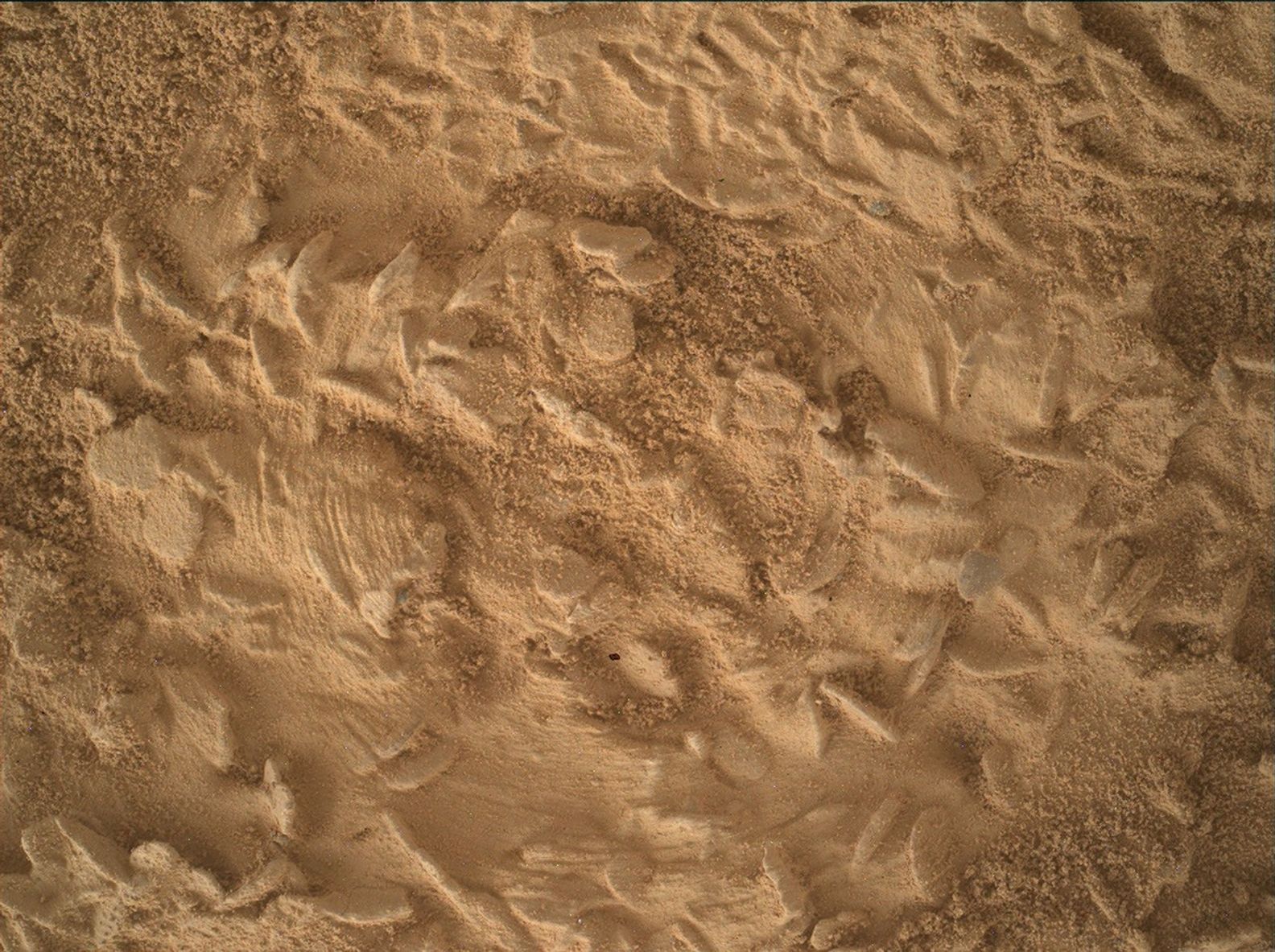
Written by Lucy Lim, Planetary Scientist at NASA’s Goddard Space Flight CenterEarth planning date: Friday, Oct. 16, 2026Following the Basque Lakes drill campaign, Curiosity has returned to a spot just a few meters away from the “Chiu Chiu” block to conduct our next drill campaign. “Chiu Chiu” itself wasn’t a good candidate for drilling but the block just beyond it was much more promising, so it became our drive target during Monday’s planning. I was on planning Friday as Geology and Mineralogy Science Theme Lead when we received our close-up views of the neighbor block from the post-drive imaging and our team was happy to see that it was jam-packed with the “disc- and needle-” shaped lumps, just like “Chiu Chiu.” We quickly gave the science go-ahead to proceed with preparations for drilling at the newly named “Nazca” site.One major hypothesis about how the “discs and needles” texture formed is that the characteristic shapes were originally created during the growth of crystals, or “crystal forms.” Minerals will tend to grow into specific shapes depending on their microscopic crystal structure, similar to the salt crystals that you can grow in your kitchen as a home science project. (Maybe you have grown one of those for a science class in school!) The relatively large sizes of the crystal forms at “Nazca” and “Chiu Chiu” are providing clues about the temperature at the time when they grew and the availability of salts and fluids. However, we can’t necessarily assume that the modern-day composition represents the original mineral because sometimes mineral crystals are replaced by other minerals some time after original crystallization. The new minerals are then known as “pseudomorphs” because they have the same shape as the first minerals but not the same composition or molecular structure. As we prepared for the drill preload test, we also planned several special observations aimed at highly detailed characterization of the crystal forms. MAHLI will execute a Quantitative Relief Model (“QRM”) observation consisting of five overlapping images at slightly different geometries. The combination of these will enable a detailed three-dimensional relief model to be constructed. In addition, MAHLI will also add extra frames to its highest-resolution imaging by doubling the number of focus mechanism steps. Together, these observations will increase the resolution of the 3D models we will have of the crystal forms.Meanwhile, the ChemCam LIBS will conduct a “depth profile” experiment to obtain compositional information from…
Lire l'article complet ici : NASA News: Curiosity Blog, Sols 5043-5049: Preparing to Drill at ‘Nazca’