




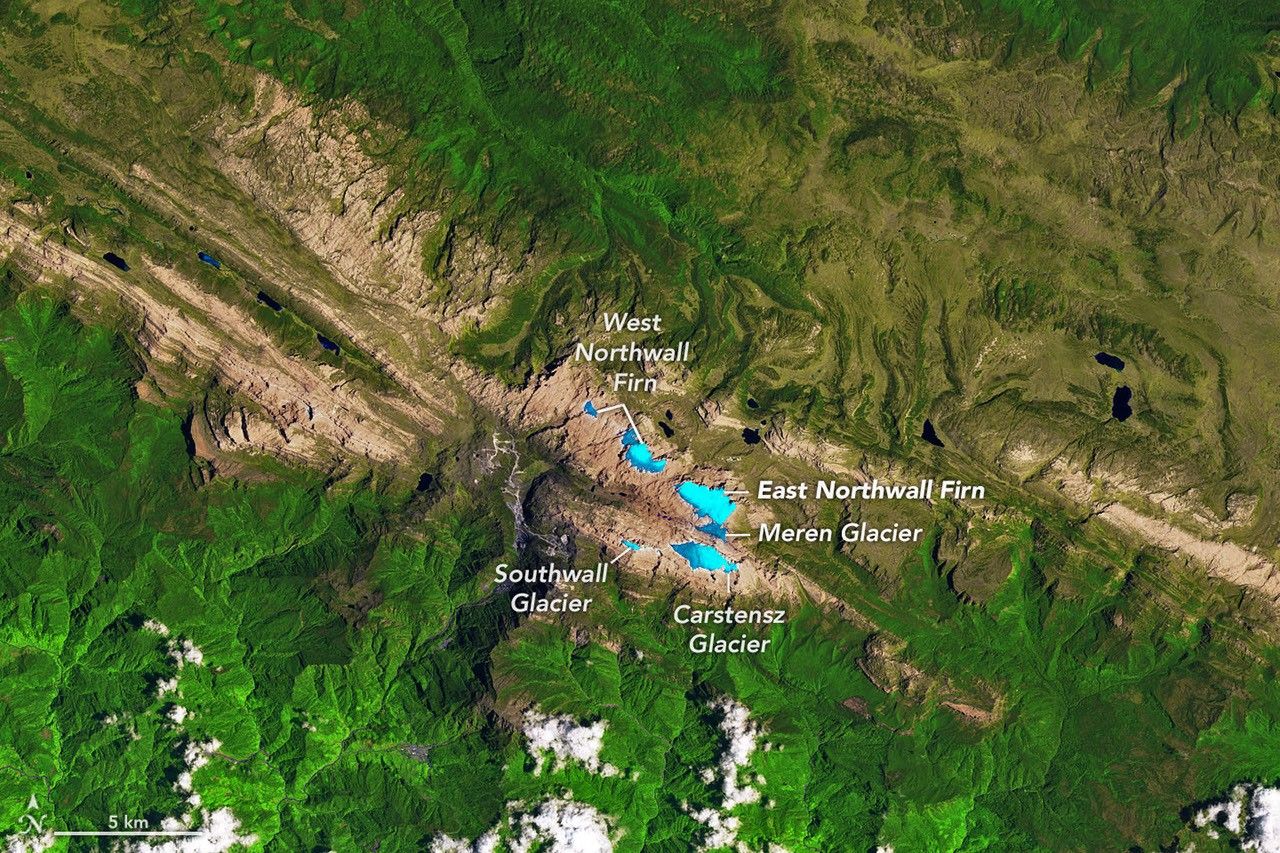
On the island of New Guinea, Indonesia’s Sudirman Range is one of the few places near the equator that have long held ice year-round. But near the summit of Puncak Jaya, the ice has dwindled to patches too small to flow like glaciers.Positioned in the tropics beside the largest expanse of warm ocean water on Earth, the range’s glaciers lie near the warmest conditions in which ice can survive year-round. Scientists have described these glaciers as high-altitude “canaries in the coal mine,” alongside other tropical ice such as the remnants of Humboldt Glacier in Venezuela, Quelccaya Ice Cap in Peru, and the ice fields of Kilimanjaro in Tanzania.The change on Puncak Jaya is visible in this image pair, acquired in 1988 by the TM (Thematic Mapper) on Landsat 5 (left) and in 2026 by the OLI (Operational Land Imager) on Landsat 9 (right). The false-color images help distinguish areas of ice (light blue) from exposed bedrock (brown). Clouds appear white and vegetation green.In 1988, the glaciers covered about 4.31 square kilometers (1.66 square miles), according to Donaldi Permana, a climate scientist at the Indonesian Agency for Meteorology, Climatology, and Geophysics (BMKG). By September 2025, satellite and aerial data showed that only about 0.09 square kilometers (0.03 square miles) remained—an area equivalent to about a dozen soccer fields. That’s roughly 2 percent of the 1988 extent. An aerial survey planned for December should yield an estimate of how much ice remains in 2026, Permana said.The glaciers have thinned, too. Measurements at the primary monitoring site on the East Northwall Firn showed a drop from 32 meters (105 feet) thick in 2010 to 4 meters (13 feet) in 2023, Permana said. By November 2024, the ice at this site was gone.As the glaciers thin, they also break apart, and each new fragment adds exposed edges where ice can melt, compounding the losses. In the 2026 Landsat image, freshly uncovered bedrock appears between the remnants. Snow still falls in the area, but it doesn’t last long enough on the bare rock to build up into new ice.“It’s a house of cards problem,” said Chris Shuman, a retired University of Maryland glaciologist who has tracked Puncak Jaya’s glaciers in satellite imagery. “Once this process gets going, there’s really no turning back.”To qualify as a glacier, a body of ice generally has to be thick enough to flow downhill under its own weight, and it…
Lire l'article complet ici : NASA News: The Last Ice on Puncak Jaya